When Kidwelly Thrived: A Portrait from Pigot’s Directory, 1835
The Pigot’s Business Directory of 1835 provides a revealing snapshot of Kidwelly at a moment when the town functioned as a small yet important centre of governance, commerce, and everyday life in Carmarthenshire. In the early nineteenth century, Kidwelly stood near the mouth of the Gwendraeth Fach River, its position linking it closely to coastal trade while remaining firmly rooted in the agricultural landscape of the surrounding countryside. Though modest in size, the town combined ancient municipal traditions with the practical rhythms of a working market town, reflecting both its medieval heritage and its place in a changing Wales.
Contemporary descriptions portray Kidwelly as orderly, industrious, and well governed. Its civic institutions, economy, and population formed a largely self-contained community, capable of sustaining itself through local skills and services. With a population of around 1,681 inhabitants, the town supported an impressive range of professions. Artisans, shopkeepers, traders, and service providers met most daily needs within the town itself, illustrating a local economy that relied little on external centres for routine goods and labour. Alongside these trades were listed members of the gentry, clergy, academics, and the staff of the National School, underscoring the town’s social structure and its emphasis on education, religion, and civic order.
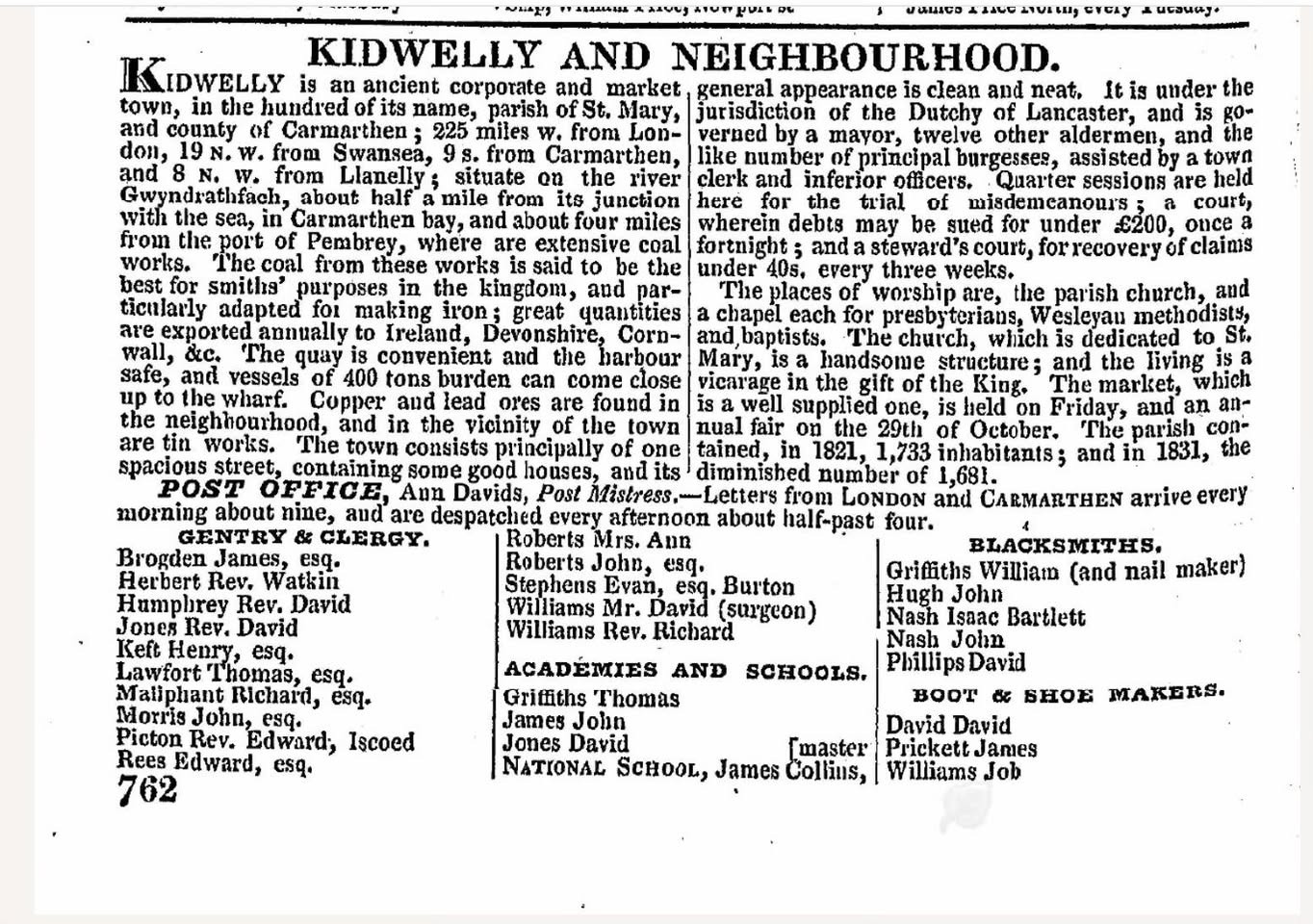
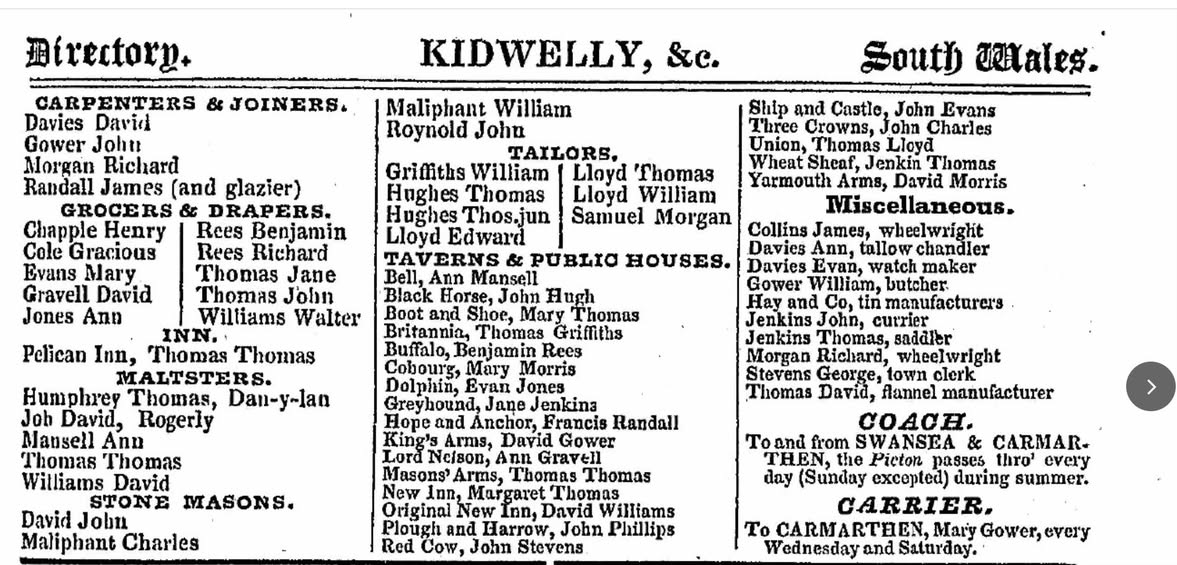
The directory also preserves the names of families who shaped Kidwelly’s life during this period—surnames such as David, Nash, Maliphant, Stephens, and Mansell. These names remain familiar in the town today, suggesting a strong continuity between past and present and highlighting the deep local roots of many Kidwelly families.
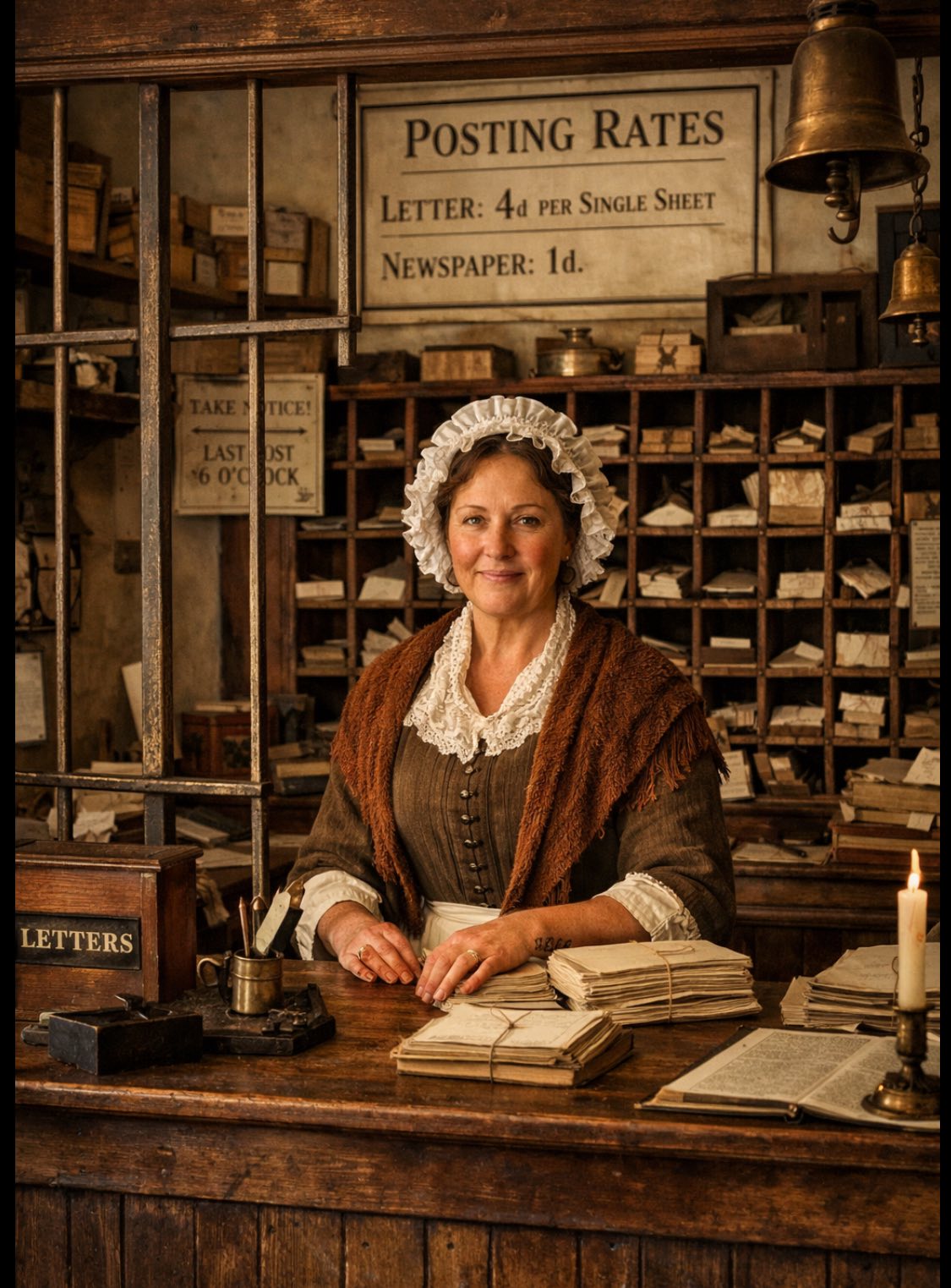
One particularly striking detail in the directory is the prominence given to Ann David, listed at the head of the professions as Post Mistress. Her position reflects the importance of the post office in nineteenth-century towns like Kidwelly. The postal service was far more than a means of delivering letters; it was the town’s principal link to the wider world. Through the post office flowed personal correspondence, commercial transactions, newspapers, and official government communications. In an age before rapid transport and electronic communication, the post office served as the community’s primary channel for news, information, and connection beyond the immediate locality.
The post office also played a central role in local commerce. Often operating from or alongside an existing business, it drew a steady stream of townspeople and visitors. Financial services such as money orders provided a secure means of transferring funds in an era when formal banking was limited, while access to mail-order goods gradually expanded the choices available to rural and small-town residents. The postmaster or postmistress was therefore entrusted with both information and money, responsibilities that demanded reliability and discretion.
As a result, the role carried considerable social standing. Postmasters were typically respected, long-serving members of the community, and the position offered a rare pathway into public office. Notably, women such as Ann David held these posts decades before gaining formal political rights, giving them a visible and influential role in public life.
Taken together, the Pigot’s Directory entry for Kidwelly in 1835 paints a picture of a thriving, self-reliant town. It reveals a community supported by a diverse local economy, shaped by enduring family networks, and firmly connected to the wider world through trade, communication, and governance. More broadly, Pigot’s Directory itself—published between the 1820s and 1850s—stands as an invaluable historical source. By recording names, occupations, and places, alongside brief local descriptions, it offers a substitute for census records and a rich insight into the social and commercial life of towns like Kidwelly during the early nineteenth century.